
“First”
(Call from Mars)
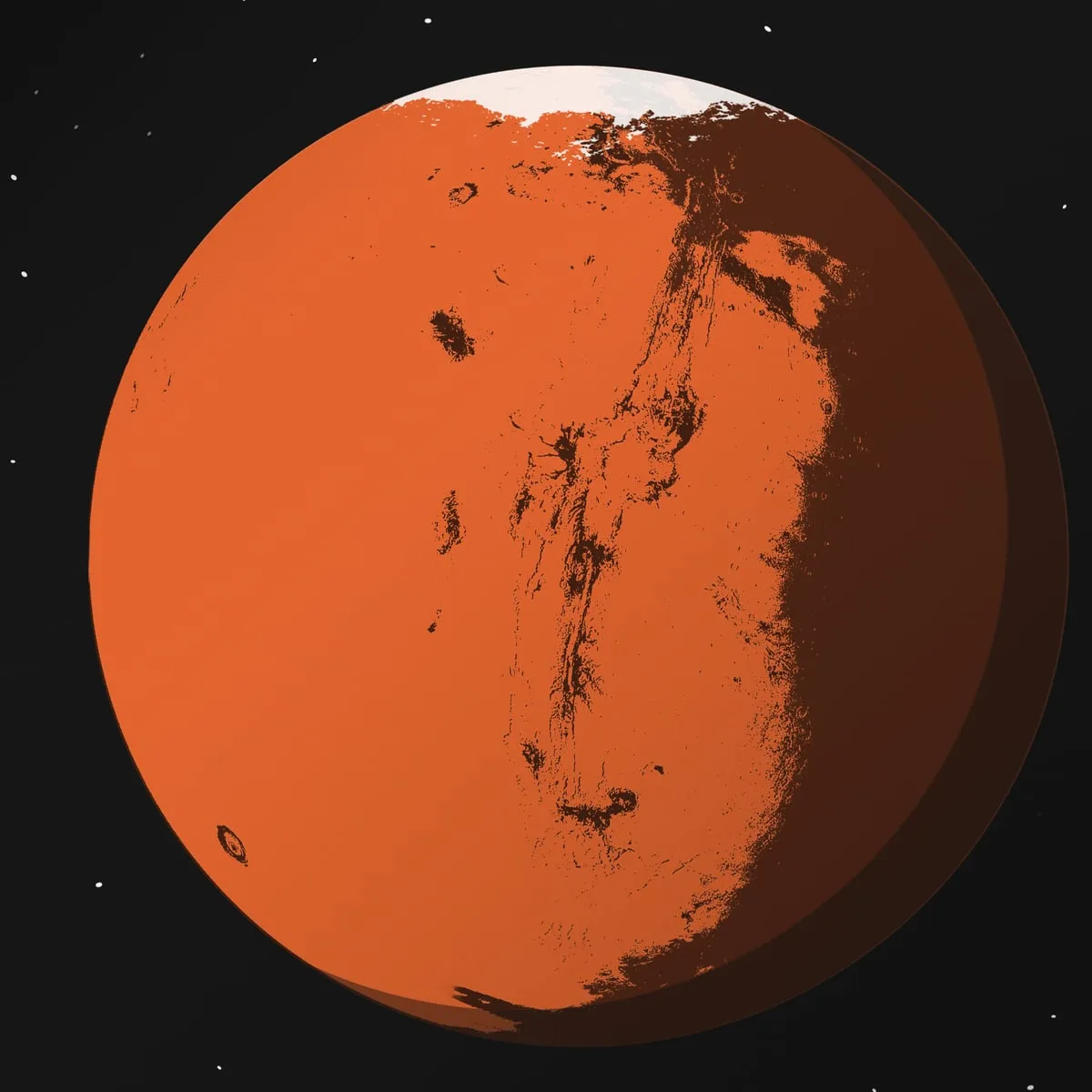
ESA's ExoMars mission was to send an audio signal from the surface of Mars back to Earth. This is the story of a song written to be that signal.
“First (Call from Mars)” was one of eleven sounds an international jury chose in 2019 to make the trip. The launch planned for 2020 was postponed and the mission rebuilt.
0:00 / 0:30
Twelve sounds from space, science and Czech music are hidden in the song.
-
Air sound 0:00
Martian Wind
Martian wind and dust, captured by NASA's InSight lander in 2018.
-
Bass & boom 0:05
Gravitational Wave
First ever observation of gravitational waves in 2015 by LIGO, converted to an audio signal.
-
Sound FX 0:08
Titan Moon
Radar echoes received by ESA's Huygens probe during its descent onto Titan in 2005.
-
Instrument 0:10
Organ
Czech historical churches are home to some of the world's greatest organs.
-
Noise FX 0:11
Whistler
Lightning strike recorded by Cluster satellites in 2001.
-
Synth source 0:12
Black Hole
First ever image of a black hole, captured by the Event Horizon Telescope in 2019.
-
Synth source 0:14
Oxia Planum
Picture of Oxia Planum, the landing site of the ExoMars rover.
-
Whoosh 0:17
Mars Express
Sound of ESA's Mars Express being tested on a special shaker in France.
-
Instrument 0:21
Cimbalom
The cimbalom is a typical instrument of Czech folk music.
-
Instrument 0:24
Strings
Ostinato inspired by the father of Czech classical music, Bedřich Smetana.
-
Shaker 0:27
Auroral ‘Star Wars’
Auroral kilometric radiation collected by Cluster satellites, resembling R2-D2.
-
Synth source 0:28
Elon Musk
Picture of the SpaceX founder and long-time advocate of Mars exploration and settlement.
Lyrics
-
When sol rose above: Mars-Day
“Sol” is the Latin word for “Sun”. Because days on Mars are 39 minutes longer than on Earth, this term was adopted to describe a Mars-day.
-
I pave a path: Space Exploration
Thanks to scientists and engineers working on space exploration, ExoMars team included, the dream of spreading mankind across our Solar System and beyond is getting more real each year.
-
Back to the stars: We're Star Stuff
The atoms in our bodies were created in previous generations of stars over 4.5 billion years ago. We are literally made of stars.
-
When the skies get dark: Multi-Planetary Species
Mankind has already put their instruments on multiple planets and other celestial bodies. We no longer recognize only one sky.
-
Keep looking up: Star Gazer
“Keep Looking Up” is Jack Horkheimer's signature closing line in his popular astronomy TV show Star Gazer on PBS, inspiring a new generation of scientists working today.
-
Light will come: Czech-Made InstrumentSpace Is Big
The instrument transmitting this song from Mars was to be the Czech-made electromagnetic wave analyzer, that would try to find out whether there is lightning on Mars.
The speed of light is the speed limit in our Universe, yet the source stars may still be billions of light years away from us. But, eventually, if we keep looking and exploring, it will reach us.
The Mission
- 2019
An international jury chooses “First” as one of eleven finalists from 600 entries.
- 2020
The planned launch. It slips to 2022 for more tests of the landing system.
- 2022
ESA suspends its cooperation with Roscosmos and rebuilds the mission with NASA and a European landing platform.
What Happened Next
The eleven sounds were to ride on a memory chip inside Kazachok, the Russian-built landing platform. There the Czech wave analyser, built at the Institute of Atmospheric Physics in Prague to listen for lightning in Martian dust storms, would have sent one of them back to Earth to check it was ready. When ESA ended its cooperation with Russia in 2022, the platform went back to Roscosmos, and the instrument and the song never left Earth.
The question still got an answer. In 2026 the same Prague scientists found the first sign of lightning at Mars, a single whistler hidden in data from NASA's MAVEN orbiter. A whistler is one of the twelve sounds in the song.
Credits
“First (Call from Mars)” by Exit Empire is released under CC BY 4.0: share it, play it and build on it, with a credit to Exit Empire. The waveform is drawn with wavesurfer.js.
Image Credits
- Martian Wind: NASA/JPL-Caltech, Public domain
- Gravitational Wave: NASA/Ames Research Center/C. Henze, Public domain
- Titan Moon: ESA/NASA/JPL/University of Arizona, Public domain
- Organ: Uoaei1, CC BY-SA 4.0
- Whistler: NOAA Photo Library, Public domain
- Black Hole: EHT Collaboration, CC BY 4.0
- Oxia Planum: NASA/JPL/University of Arizona, Public domain
- Mars Express: ESA/ATG medialab; Mars: ESA/DLR/FU Berlin, CC BY-SA 3.0 IGO
- Cimbalom: maxmann, Pixabay, CC0
- Strings: Jan Vilímek, Public domain
- Auroral ‘Star Wars’: NASA, ISS Expedition 23 crew, Public domain
- Elon Musk: U.S. Air Force/Trevor Cokley, Public domain